Audiobook Production

ACX Exclusive vs Non-Exclusive: Which Is Right for Your Audiobook?

If you're getting ready to publish an audiobook through ACX, one of the biggest decisions you'll make is whether to choose exclusive or non-exclusive distribution.

It's also one of the questions authors ask us most often through our audiobook production services.

The difference isn't just about royalty rates. Your choice determines where you can distribute your audiobook, whether you can sell it through other channels, and how much flexibility you'll have after launch.

Here's the short answer:

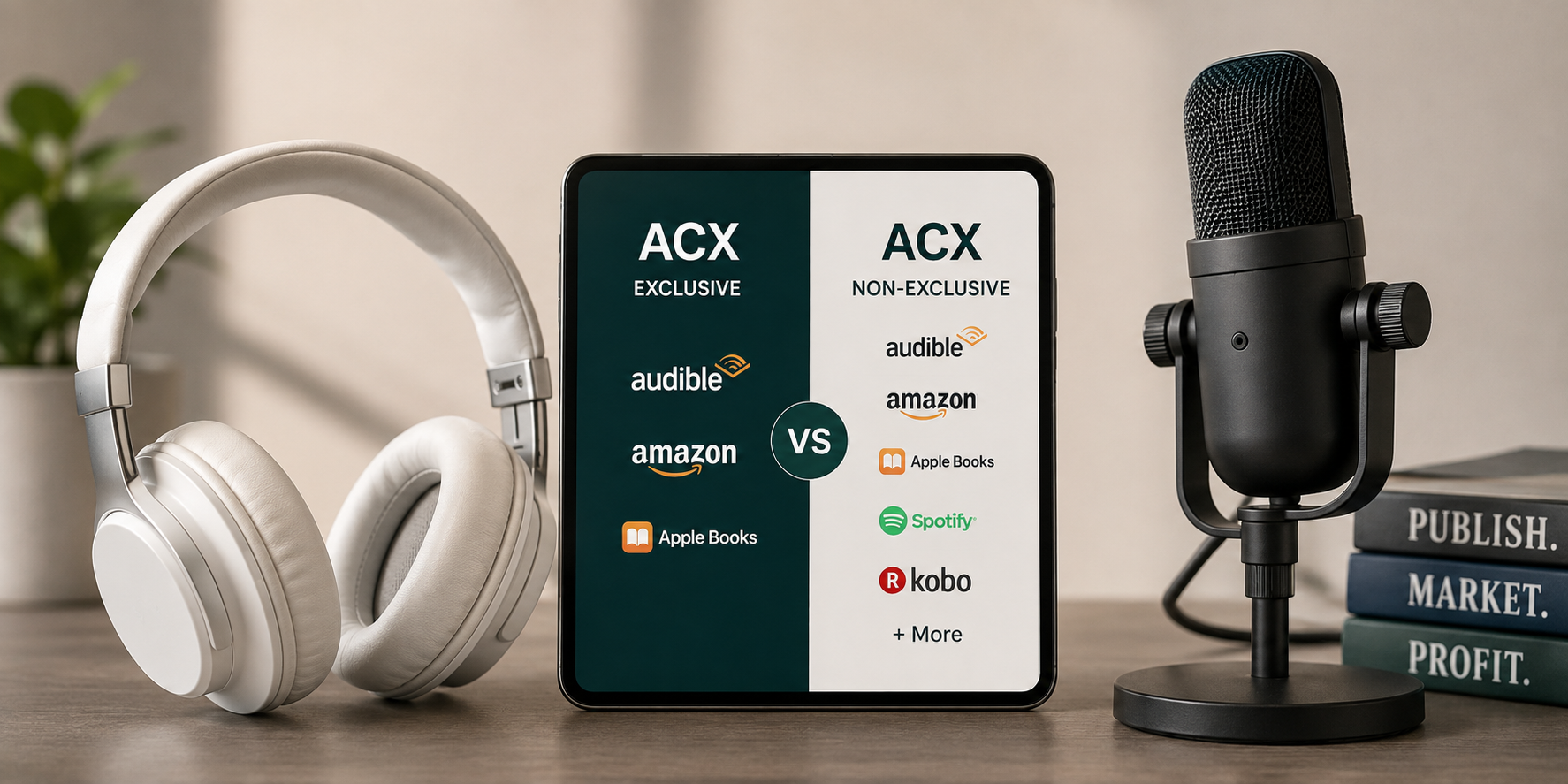
ACX exclusive distribution gives you a higher royalty rate on Audible, Amazon, and Apple Books, but you cannot distribute your audiobook elsewhere. Non-exclusive distribution gives you a lower royalty rate through ACX but allows you to distribute your audiobook through other retailers, libraries, and channels.

For many first-time authors, exclusive distribution makes sense. For authors who prioritize wide distribution, libraries, direct sales, or using their audiobook as part of a larger business, non-exclusive may be the better option.

Let's break down the differences.

Note: ACX royalty rates changed in 2026. If you've researched this before, you may have seen 40% for exclusive and 25% for non-exclusive. Audible introduced a new royalty model on May 26, 2026, and the current ACX royalty rates are 50% and 30%. A lot of the advice still circulating online reflects the old numbers.

How Big Is the ACX Distribution Side?

Before weighing the tradeoff, it helps to understand what exclusive distribution actually reaches.

The U.S. audiobook market reached $2.43 billion in 2025, up 9% year over year, according to the Audio Publishers Association's annual sales survey. Audible is widely considered the dominant audiobook retailer in the U.S., although Amazon does not publish Audible's market share as a standalone figure.

Exclusive distribution also reaches beyond Audible itself. Your audiobook is distributed through Amazon and Apple Books, and eligible titles can benefit from features such as Whispersync for Voice, which allows Kindle readers to add the audiobook at a discounted price.

That reach is an important part of the case for exclusive distribution, beyond simply earning the higher ACX royalty rate.

What Is ACX Exclusive Distribution?

When you choose exclusive distribution through ACX, Audible distributes your audiobook through Audible, Amazon, and Apple Books.

In exchange for giving Audible exclusive distribution rights, you receive the higher ACX royalty rate.

Under Audible's current royalty model, exclusive titles earn a 50% royalty rate.

Exclusive titles also get access to ACX promo codes. You receive 25 codes per book for each of the U.S. and UK marketplaces, which you can provide to reviewers to help generate early reviews. Non-exclusive titles don't receive these promo codes, making this a useful launch tool for exclusive titles.

The tradeoff is important: while your audiobook is exclusive, you cannot independently sell or distribute it through other retailers or distribution channels.

That means you cannot take the same audiobook and distribute it to places such as Spotify, Kobo, Google Play, libraries, or your own direct-sales channels. If you already have an audience or other channels you want to distribute through, this is an important limitation to consider.

For many authors, that's an acceptable tradeoff. Audible remains the most important audiobook marketplace, and exclusive distribution keeps things relatively simple.

What Is ACX Non-Exclusive Distribution?

Non-exclusive distribution gives you considerably more flexibility.

Your audiobook can still be distributed through ACX to Audible, Amazon, and Apple Books, but you are also free to distribute it through other audiobook retailers and services.

Under Audible's current royalty model, non-exclusive titles earn a 30% royalty rate through ACX.

In exchange for the lower royalty rate, you can pursue additional distribution opportunities, including:

  • Spotify

  • Kobo

  • Google Play

  • Other audiobook retailers

  • Library distribution

  • Direct sales through your own channels

It's important to understand that ACX does not handle those additional channels for you. Non-exclusive simply gives you the right to distribute elsewhere. You or your audiobook distribution partner will need to arrange that additional distribution separately.

ACX Exclusive vs. Non-Exclusive Royalty Rates

The biggest difference authors usually notice first is the royalty rate.

Under Audible's current royalty model:

ACX Exclusive

50% royalty rate

Distribution outside ACX: No

ACX Non-Exclusive

30% royalty rate

Distribution outside ACX: Yes

These rates increased when Audible introduced its new royalty model in May 2026. The previous rates were 40% for exclusive distribution and 25% for non-exclusive distribution.

Audible also changed how some membership listening royalties are calculated. Under the current model, royalty earnings can include listener engagement through Audible membership offerings rather than being based solely on traditional individual purchases.

Because audiobook royalty programs can change over time, always confirm the current rates and terms with ACX before making your final decision.

Is ACX Exclusive or Non-Exclusive Better?

For many authors, exclusive is the better fit.

If your primary goal is simply to sell your audiobook to audiobook listeners, exclusive distribution can be an attractive option.

You receive the higher ACX royalty rate while still reaching Audible, Amazon, and Apple Books.

In our experience producing and distributing audiobooks, most authors choose exclusive distribution.

It's particularly worth considering if:

  • Your main goal is earning royalties from audiobook sales

  • You don't already have a large audience or direct-sales channel

  • Library distribution isn't important to you

  • You don't need to sell the audiobook independently

  • You want to keep distribution relatively simple

For a first-time author who mainly wants their audiobook available where a large number of audiobook listeners already shop, exclusive distribution can make a lot of sense.

When Does ACX Non-Exclusive Make More Sense?

The decision changes when reaching more channels is more important than maximizing your ACX royalty percentage.

This comes up frequently with business authors, consultants, founders, speakers, and executives.

For these authors, the audiobook may be more than a product.

It can be a way to build authority, reach potential clients, support speaking engagements, expand the audience for a book, or become part of a larger content and marketing strategy.

In those situations, having the freedom to distribute the audiobook more widely may be worth giving up the higher ACX royalty rate.

Non-exclusive distribution is worth considering if:

  • You want your audiobook available through additional retailers

  • You want library distribution

  • You want the flexibility to sell or distribute the audiobook through your own channels

  • You have an existing audience outside Audible

  • Your book supports a business, speaking career, course, or larger brand

  • Maximum reach matters more to you than earning the highest possible royalty rate through ACX

For these authors, the audiobook's value may not come primarily from the royalty earned on each sale.

A business book that leads to a consulting engagement, speaking opportunity, customer, or business relationship can be worth considerably more than the audiobook royalty itself.

What About Audiobook Distribution to Libraries?

This is one of the clearest reasons to consider non-exclusive distribution.

ACX does not currently distribute audiobooks to libraries.

If you want your audiobook to be available through library channels, you'll need to choose non-exclusive distribution and arrange library distribution outside ACX.

The library audiobook market is substantial and still growing. Readers borrowed 315.9 million audiobooks through OverDrive's Libby and Sora apps in 2025, a 13% increase over the previous year.

For some authors, libraries aren't a priority.

For others, especially nonfiction authors, educators, publishers, and authors focused on broad accessibility, library availability can be an important part of the distribution strategy.

Can I Switch From ACX Exclusive to Non-Exclusive Later?

Yes, but you should still think carefully before choosing.

Under ACX's current agreement, you can make a one-time request to change between exclusive and non-exclusive distribution after your audiobook has been available for sale for at least 90 days.

ACX states that it will process the request within 30 days.

After that one change, ACX does not guarantee you'll be able to change your distribution election again. It's best to plan as though you get one change.

That means you do have some flexibility if your strategy changes, but it's still better to think about your long-term distribution goals before publishing.

There is also an important exception: certain Royalty Share arrangements require exclusive distribution and cannot be changed. Always check the terms of your specific production and distribution agreement.

Should I Start Exclusive and Switch to Non-Exclusive Later?

Some authors consider launching exclusively and changing to non-exclusive later.

That can work, but it isn't automatically the best strategy.

Keep the timeline in mind. Ninety days of required sales history plus up to 30 days of processing means it could be around four months before you can begin distributing your audiobook elsewhere.

Those first few months are also typically an important launch period, when your promotion and publicity efforts are at their strongest.

If you already know that libraries, additional retailers, or independent distribution are important to your launch, waiting several months to expand your distribution may work against your goals.

On the other hand, if you're a first-time author primarily focused on Audible and aren't sure whether wide distribution will matter, starting exclusive may be reasonable.

The better question isn't:

"Which option pays more?"

It's:

"What do I want this audiobook to do for me?"

That's usually what determines the right answer.

ACX Exclusive vs. Non-Exclusive: Our Recommendation

There isn't one distribution option that's best for every audiobook.

Consider ACX exclusive if your main goal is selling the audiobook through the major ACX channels, you value the higher royalty rate, and you don't need additional distribution.

Consider ACX non-exclusive if you want broader distribution, library availability, independent sales options, or more control over where your audiobook can appear.

For many first-time and fiction authors, we'd lean toward exclusive.

For business authors, speakers, consultants, publishers, and authors with an existing audience or broader distribution strategy, we'd take a serious look at non-exclusive.

The right decision depends less on the royalty percentage itself and more on what role the audiobook plays in your overall goals.

If you're still deciding how to produce your audiobook, we've also put together a guide comparing some of the top audiobook production companies and publishers.

Frequently Asked Questions

What is the difference between ACX exclusive and non-exclusive?

ACX exclusive distribution gives Audible exclusive rights to distribute your audiobook and offers a higher royalty rate. Non-exclusive distribution offers a lower royalty rate but allows you to distribute your audiobook through other retailers and channels as well.

What are the ACX exclusive and non-exclusive royalty rates?

Under Audible's current royalty model, ACX pays a 50% royalty rate for exclusive distribution and a 30% royalty rate for non-exclusive distribution. These replaced the previous 40% and 25% rates in May 2026. Rates and royalty programs can change, so confirm the current terms with ACX before publishing.

Where does ACX distribute my audiobook?

ACX distributes qualifying audiobooks to Audible, Amazon, and Apple Books. Choosing non-exclusive distribution allows you to arrange additional distribution outside ACX.

Can I distribute my audiobook to libraries through ACX?

No. ACX does not currently provide library distribution. If library distribution is important to you, you'll need to choose non-exclusive distribution and arrange it separately.

Can I sell my audiobook directly if I choose ACX exclusive?

Generally, no. Exclusive distribution grants Audible exclusive distribution rights, so you cannot independently sell or distribute the same audiobook through your own channels while that exclusivity applies.

Non-exclusive distribution gives you that freedom, though you'll be responsible for driving the audience and sales yourself.

Can I switch from exclusive to non-exclusive on ACX?

Under ACX's current agreement, you can request a one-time change between exclusive and non-exclusive distribution after your audiobook has been available for sale for at least 90 days. ACX does not guarantee any change beyond that one.

Is ACX exclusive worth it?

It can be. Exclusive distribution offers a higher ACX royalty rate and may be a good fit for authors primarily focused on selling through Audible, Amazon, and Apple Books.

Non-exclusive may be better if wider distribution, libraries, or independent sales are important to your strategy.

Need Help Producing or Distributing Your Audiobook?

At Jony Studios, we help authors through the entire audiobook production and distribution process.

We've worked on audiobook and audio projects for authors, publishers, and organizations including Penguin Random House, Amazon, and Baker Tilly. For example, see how we handled an end-to-end remote audiobook production for Guilford Press, coordinating a 236,000+ word production with four performers across multiple locations.

Whether you're narrating the book yourself or working with a professional narrator, we can help with the recording process, editing, mastering, and distribution. We handle both ACX and wider audiobook distribution, so our goal is to help you choose the option that makes the most sense for your book.

If you're not sure whether ACX exclusive or non-exclusive distribution is right for you, we can help you think through your options as part of the process.


Ready to Produce Your Audiobook?

Whether you’re narrating it yourself or working with a professional narrator, Jony Studios can help with the entire audiobook production and distribution process.


ACX royalty rates, distribution terms, and program features can change. This article reflects ACX's current published terms at the time of its most recent update. Always review your current ACX agreement and account terms before making a distribution decision.
Best Audiobook Production Companies for Entrepreneurs and Business Leaders

US audiobook sales revenue hit $2.43 billion in 2025, up 9% over the previous year, according to the Audio Publishers Association. Nonfiction is driving a growing share of that growth, with the category projected to expand roughly four times faster than fiction over the next several years, a sign that business authors and entrepreneurs are no longer treating audio as optional.

Finding an audiobook production company that is best equipped to meet your specific needs and help you produce the highest quality product possible is crucial. Whether you are prioritising done-for-you full service, or companies that specialize in individual services, you will benefit from external expertise, and improve your brand visibility.

Here you will find the top audiobook production companies suited towards a variety of differing needs, and learn about what sets each one apart from the rest. 

Production Companies vs. Publishers 

If you are unfamiliar with the process of producing and distributing an audiobook then these two terms may sound interchangeable to you, however this is not the case. When publishing your book yourself, partnering with a production company is typically what will work best for you, because this company will allow you to maintain a large amount of control over your audiobook and how the final product turns out. 

Publishers, alternatively, are purchasing the rights to your book, meaning that you will sign a contract and be provided with an advance, allowing the publisher to make all major decisions and take over control of the production, distribution and marketing process. The publisher is also gaining all of the profits from your book, excluding your agreed upon royalty.  

Production companies instead allow you to be involved creatively with the production process, including helping with decisions like who the narrator will be and what changes you want made. You are also keeping the rights to your book, and taking in the profit yourself. While some production companies may want part of the future royalties on your book, other payment options can include a PFH rate or a flat fee depending on the specific company. 

When considering both of these options, it’s important to remember that because you are creating an audiobook, you will still be able to distribute through popular channels like Audible, Apple Books and Amazon if you choose not to pursue the traditional publishing route. 

This means you can retain the rights to your work and still reach your audience, allowing you to repurpose that content into marketing assets for your business.  

Here are the best audiobook production companies for entrepreneurs and business leaders: 

1.  Jony Studios

Jony Studios is a full-service audiobook production and distribution company that works with authors across a wide range of genres, but has built a specialized process for entrepreneurs, founders, and business leaders who want to turn their book into a long-term business asset.

Because the company is led by a B2B marketer, every project is approached with an understanding that an audiobook should do more than generate royalties. It should strengthen your brand, create marketing content, and build authority long after launch.

Casting isn't finalized until you approve a narrator who's the right fit for your brand and your book, not just whoever's available. For a recent Guilford Press audiobook, the team auditioned 10 narrators before landing on the final cast. Jony Studios has also produced audiobooks for Amazon, Penguin Random House, and Brilliance Audio.

Whether you choose to narrate the book yourself or work with a professional narrator, the team guides you through every stage of the process, from preparing your recording setup to final approval before distribution. Production, editing, and full distribution through ACX and Voices by INaudio (formerly Findaway Voices) to Audible, Apple Books, Spotify, and other major retailers are all handled by one team, giving you a single point of contact from manuscript to retail. You retain full ownership of your audiobook and its royalties.

Unlike companies that charge per-finished-hour rates, Jony Studios uses fixed package pricing, so you know your total investment before production begins. Pricing is based on your manuscript's word count and whether you narrate the book yourself or work with a professional narrator. Simply submit your approximate word count for a free estimate, typically sent within 24 - 48 business hours.

2. Scribe Media

Scribe Media is a done-for-you production company that handles the entire creation and distribution process, from recording to final delivery, best suited to entrepreneurs and business leaders who'd rather work with one company than coordinate several. Audiobook production is one part of a broader book-writing and publishing service rather than their core specialty. The company operates under new ownership following the original Scribe Media's 2023 financial collapse and bankruptcy, now led by CEO Eric Jorgenson and backed by Enduring Ventures. As with most bundled pricing, you'll pay for distribution as part of the package even if you don't need it.

Their done-for-you service means that they will take care of and include you in all aspects of the process, including recording, editing, sound engineering, quality control and distribution, allowing you to optimize the audio for specific distributors or platforms. 

You have the option of choosing a narrator, or narrating yourself, and the guidance and assistance of professionals and sound engineers to adjust the recording, all while keeping in mind your preferences. Since they are not a traditional publisher, your audiobook and its royalties stay entirely yours. Generally prices for audiobook production start at $8,000, but you will be quoted for the exact cost of your specific project. 

3. Lucent Audio

Lucent Audio is a full-service audiobook production company that provides everything from pre-production to recording to distribution, and their team, including top sound engineers ensure that your product is high quality through their QC reviews that take place during post-production. 

With services starting around $5,000, you also have the option to use the company for distribution only, which starts at around $1,000, meaning you can partner with other companies as well for the production process. 

Your audiobook remains entirely your property when you partner with Lucent Audio, and you'll work directly with founder Jeff Guillot and his team to tailor the project to your specifications. This company is best suited to first-time audiobook authors, especially founders with no prior audio experience, or anyone who wants help specifically with distribution.

4. Mosaic Audio

Providing audiobook services that include all aspects of the process from production to distribution, Mosaic Audio is an LA based production company known for working with famous clients and creating high-quality audiobooks to meet celebrity standards. 

Their studios however are only located in the LA area, meaning some of your recording options, like narrator and language choices may be limited. 

In the past they have worked with both traditional publishers and independent authors, but have now shifted to working primarily with publishing companies, meaning that if you're self-publishing and want to hold onto ownership of your work so you can reuse it in your own content and marketing, this company is likely not your best option.

5. John Marshall Media

With versatile services and experience producing audiobooks of many different genres, John Marshall Media has the notoriety and skillset that comes from working with major publishers, but will still work with individual authors, helping founders and independent authors who want to keep full ownership of their content make a high quality product, through their network of sound engineers and narrators trained to keep listeners engaged with your content.

Their services include marketing, distribution, delivery, recording and script and narration guidance. If you want to narrate your own book, then you have that option because they have studios around the world. 

They are best suited towards authors who want a full service experience, since things like marketing are included, meaning this may not be the best fit if you want to outsource promotion to another company. 

6. Deyan Audio

With over 30 years of experience in audiobook production, Deyan Audio provides an extremely comprehensive list of done-for-you services that help to optimise your content, with their full package option including more unique options like direction, reformatting, overall management and pronunciation research. 

With this company you are paying PFH rather than a flat rate, meaning that full ownership of your audiobook stays with you, and pay around $460–$750 per hour for full production. You also have the option of paying for individual services, like audio editing ($75 PFH), quality control ($50 PFH), and mastering ($25 PFH), plus distribution benefits through their partnership with Author's Republic where your royalty deal can be improved, making this a better fit for any business leader prioritizing individual upgrade options and paying for only what they need.

7. Novel Audio

Novel Audio is a production company that provides services for authors who are both published through traditional publishers and who are self-published, and take on both the production and distribution of the audiobook with connections to platforms like Nook and Audible. 

Novel Audio claims that they accept submissions so long as there are previous sales connected to your book. 

By partnering with Novel Audio, you will not be able to retain the audio rights to your book because they purchase them once they take on your project, meaning that you will have to relinquish control of your content, and there is no clear indication of whether you will receive royalties from the audiobook or if you will instead be granted an advance. 

8. Punch Audio

Punch Audio is a production company based in both Los Angeles and Florida, making them best suited to founders and authors based near either location if they want to be closely involved with the work being done in the studio. 

If you are looking to keep down costs while creating your audiobook, you are given the option to go in on their royalty share scheme as well.

You are able to maintain creative control over multiple aspects, including who will narrate the book, meaning that you can tailor the product to align with your brand image. If you want to narrate your own book the cost for around an hour of audio, or 10,000 words, ranges $600 - $725, while having a professional narrate ranges $575 - $750.  

9. ACX

ACX, or the Audiobook Creation Exchange, is a production marketplace made by Audible. While Audible does sometimes buy rights and produce audiobooks directly, ACX serves a different purpose: it's a marketplace connecting authors who want to keep ownership of their work with the narrators, engineers, and producers who can bring it to life. Think of ACX as the middle-man, not the buyer.

Something to keep in mind is that you will be responsible for reaching an agreement with these industry professionals about payment, which typically is a PFH rate or taking a share of the royalties, which could be up to half through the ACX royalty share program where you will have to also distribute your book only through ACX. 

Their other options for distribution include both non-exclusive and ACX exclusive, meaning you have to choose between distributing everywhere and gaining less of the royalties or distributing to only Audible, Apple and iTunes.

10. Author's Republic

Author’s Republic offers done-for-you and independent audiobook production services that allow you to be involved with creation process yourself, connecting you to and letting you audition narrators and then facilitating your exchanges and helping you to distribute the product, or connecting you with a production manager who takes over the entire process and does things like finding a narrator and editing the audiobook for you. 

The cost typically ranges from $150 - $400 PFH, and Author’s Republic receives part of your audiobook’s revenue once it has been distributed through their channels. 

Since their services are focused primarily on aggregation of professionals like narrators, and customer support through the process, this company is best suited to independent authors, like up-and-coming entrepreneurs who are looking to find an accessible way to produce their content. 

11. Voices by INaudio (formerly Findaway Voices)

Voices by INaudio is an audiobook production company that optimises the process of audiobook creation and gives you the opportunity to widen your audience and turn your audiobook into an asset for your business. They do this by not only helping you to make and non-exclusively distribute your content, but by providing you with reports about the performance of your audiobook, and marketing tools and connections to help make your book more visible to your audience. 

The platform is independent, and many of the team members are former Findaway Voices industry professionals. 

Since they are not a traditional publisher, ownership stays with you, and you choose which distribution channels to use. As a newer platform though, Voices by INaudio is still limited in the production services that they can provide. 

The Big 5/Traditional Publishers 

If you want to partner with a traditional publisher, some of the top options include:

  1. HarperCollins/Harper Audio

  2. Macmillan Audio

  3. Hachette Audio

  4. Penguin Random House Audio

  5. Simon & Schuster Audio

  6. Brilliance Publishing

The main benefit of partnering with a traditional publisher is the increased possibility for media coverage, which can help you reach a wider audience and build authority in your field faster than going the independent route.

However, a publishing deal is extremely difficult to procure, and for audiobooks, the main distribution channels can be the same whether or not you partner with a publisher or a production company, meaning your content is still available to interested consumers. 

How to Choose the Right Audiobook Production Company or Publisher

With more than a dozen credible options above, the right choice comes down to answering a few honest questions about your priorities:

Do you want to keep full ownership of your work?

If yes, a production company is the right lane. Traditional publishers and companies like Novel Audio, which purchase rights, take that decision out of your hands.

Will you reuse the audio in your own marketing?

If your audiobook is going to fuel podcast clips, social content, or sales material, prioritize companies that let you keep full rights and don't restrict how you use the finished files.

Do you want one company handling everything, or are you comfortable managing a few vendors?

Full-service options like Jony Studios, Scribe Media, or John Marshall Media simplify the process into one relationship. Marketplaces like ACX or Author's Republic can save money but require more of your own time managing narrators and logistics.

What's your budget and timeline?

PFH-based companies like Deyan Audio let you pay only for the specific services you need, while flat-fee, full-service options offer more predictability if you'd rather not estimate hours in advance.

There's no universally "best" answer here, only the best fit for what you're trying to build.

Conclusion 

The right audiobook partner comes down to one trade-off: how much control you want to keep versus how much you want handled for you. Marketplaces like ACX reward authors willing to manage the process themselves. Traditional publishers offer reach in exchange for giving up rights and creative say. Full-service production companies sit in between, and for founders and business authors specifically, that middle ground usually wins, since it lets you keep ownership of the content while still getting a polished, professional result you can put to work in your marketing.

If you want that experience without piecing together multiple vendors, Jony Studios handles production and full distribution in one place, built specifically for entrepreneurs and business leaders turning their book into a growth asset.

Written by Eva Geimer

How to Add a PDF Companion to Your ACX Audiobook

Turning your book into an audiobook is a great way to reach a wide audience, and adding a PDF companion document only increases the impact and appeal that your book will have on a reader.

While it may sound like a daunting task to create an audiobook in the first place, partnering with an audiobook production company means that you are working with people with professional experience, who can take care of the whole process from production to distribution.

Your final product will be polished, and up to the standards of popular distributors, allowing you to expand your reach.

Introduction

It might seem like producing your book in the audiobook medium is not conducive with the content or structure of your work, but even if you have included additional visual content in your original work, for most books, this is not the case.

If your book includes pictures, charts, graphs, maps or any other information or resources that cannot be conveyed through audio, this should not stop you from turning your book into an audiobook. You should instead create a PDF to accompany your audiobook that contains all of this content.

A PDF companion document, or, an accompanying PDF is a document that is provided to the consumer alongside your audiobook. This PDF allows the listener to refer to things like visuals that would have been included in a physical copy of the book.

ACX supports companion PDFs, but there are specific guidelines you must follow in order for the document to meet the ACX requirements.

What ACX Allow/Official Rules

Following the ACX requirements is essential when creating your audiobook’s accompanying PDF document, and the first important thing to remember is that you can only have one PDF per title.

The PDF must be sent as a single file, so you have to include all of the content that you wish to accompany your audiobook here. The file itself has to be 99 MB or smaller or else it will not be accepted by ACX.

You have to then compress your PDF into a ZIP file version which is 25 MB or smaller so that you can send it in an email to ACX. In order to contact ACX by email you will have to use your registered ACX email account.

When you email ACX to send them your document, it is important that you remember to indicate when you want the PDF companion document to be available. You can choose to make it available either before the purchase of your title or after the purchase of your title, meaning that the document would then show up in the consumers library.

Keep in mind that your title must be in production for you to be able to send the file for your PDF companion document.

How to Create a Good Companion PDF

When making a companion PDF there are lots of different components that you can add in, and this supplementary content can include things like charts, tables, extra visuals, resources for your readers, a glossary, a reading guide, maps and so much more. Whatever extra content that you cannot convey in an auditory medium can be included here.

The format of your PDF is very important when it comes to clarity for your audience. There are 5 components that you should add to keep things organized:

1. The first is a title page. Here you will include your book’s title, copyright information, and an additional title indicating that this is not just a written copy of your work, but an additional supplementary document.

2. Next is a table of contents. This component is only necessary if your accompanying PDF is long enough that you need a way to navigate through the content.

3. Then you should organize your supplementary content by chapters. Under each chapter’s name you should include the images, charts, footnotes, links, and all other visual content pertaining to that specific chapter.

4. At the end of the PDF you should include an additional section, or backmatter, with information about you, the author, including a short biography and your contact information.

5. Lastly, including a call to action where you prompt your reader to review the book, this being on ACX or elsewhere, can help with audience engagement, and with getting your book noticed.The way that you present your content in the document is going to change the readability, so keeping in mind the above formatting can help.

Additionally, content presentation can alter the file size of your PDF, and to stay at or under 99 MB you might have to optimize your PDF in order to reduce your file.

There are two simple ways to do this:

The first is to remove unnecessary fonts. When you have many different fonts and those fonts are embedded so that they appear correctly on every device, the font file takes up space in the PDF

The second thing you can do to reduce is to change the resolution and colour of your images. If your images are in colour or are of a high DPI (dots per inch), this is taking up space.

Instead consider switching to a lower resolution, monochrome or grayscale, or both for your images.

Another thing you could try is compressing your file using a PDF compressor tool, like the one created by Adobe Acrobat.

The final thing to keep in mind is making sure that your companion PDF reads well and makes sense to others. Once you are sure your PDF meets all of the above requirements, run it past someone with fresh eyes to test out its compatibility with your audiobook.

Technical Steps / How to Send to ACX

Compressing your PDF file into a ZIP file might feel like one of the most complex steps in preparing your PDF companion document, but following these instructions will help you to do it, whether you have a Mac or Windows.

Mac ZIP File Instructions:

1. In either a Finder window or on the desktop, control-click on the file

2. When the shortcut menu appears select Compress

3. The compressed file will have the same name as the original, but with a .zip extension on the end

Windows ZIP File Instructions:

1. Right-click or press and hold on the file

2. Select the Send to option

3. Then select Compressed (zipped) folder

4. The zipped folder will have the same name, so if you wish to rename it you have to right click on the file and select Rename

When you are sending the ZIP file by your registered ACX email it is important to remember to include the name of your audiobook, and to let ACX know that you want this file to be a PDF Companion document for your book. You also must include if you want the PDF to be available before purchase or after purchase.

Common technical mistakes to avoid when preparing or sending accompanying PDFs include:

1. Not checking that the ZIP file is 25 MB or smaller

2. Sending a PDF file in the email to ACX instead of a compressed ZIP

3. Sending the email with your PDF companion document using your personal email account instead of your ACX registered account

For official ACX submission guidelines, visit the ACX Help Center.

When & Why to Use Companion PDFs

A companion PDF can be great for both nonfiction and fiction audiobooks.

For nonfiction books, an accompanying PDF can sometimes feel necessary when things like data sets, graphs and charts are integrated into the physical book.

By including these visuals for your audiobook listeners you can adjust the text being read by the narrator, allowing them to point the listener to the supplementary document in order to maintain the full intended effect of your book.

For fiction novels, including materials like maps or footnotes can be important for immersion and world building, and this is the optimal way to ensure your listeners are not missing out on this.

Further, adding supplementary material to your audiobook can be a great tool to increase its marketability.

Oftentimes, people are deterred from purchasing audiobooks because they enjoy the visual and physical aspect of a printed copy. However, by attaching a companion PDF you can incentivize this portion of your potential audience to purchase your book in this medium.

This is all because you are offering them something visual in combination with the convenience of an audiobook. This comes all the while you’re benefiting from the increased popularity of the auditory medium, which has recently become so popular because of its easy accessibility.

This way you can appeal to the interests of the most people possible. Not only are you enhancing the experience of your readers by giving them access to materials that provide an additional layer of information and engagement, you are increasing the discoverability of your book because of its broad appeal.

Whether this be through visual diagrams in a nonfiction work or materials that prompt further contemplation like reading guides in fiction, the materials in an accompanying PDF can give you the edge over the competition.

When a Companion PDF Isn’t Needed

Even if your book includes visuals, tables, or figures, creating a full companion PDF isn’t always necessary.

For shorter books or titles with only a few visual elements, it can be just as effective to keep things simple. In these cases, adding a short note narrated in both the Opening and Closing Credits works well, for example:


“Please note, all tables and figures referenced in this audiobook can be found in the print or ebook edition.”


This approach not only streamlines production and reduces costs but also encourages listeners to explore your print or ebook version for a more complete visual experience. It’s a practical alternative that still keeps your audiobook professional, polished, and listener friendly.

Hosting Your Companion PDF on Your Website

Another great option is to host your companion PDF directly on your own website rather than relying solely on ACX. This gives you more control, allows you to make updates anytime, and helps drive traffic back to your author or business platform.

You can include this website mention in your audiobook’s description or naturally in the Opening or Closing Credits. For example, most publishers use a straightforward approach such as:


“Visit yourwebsite.com/book-title to download the companion materials.”


For business or personal brand titles, you can make it slightly more engaging, for instance:

“You can download the companion PDF and bonus resources at yourwebsite.com/book-title”

or

“For additional visuals and worksheets, visit yourwebsite.com/book-title.”


Each variation works well depending on the tone of your audiobook, use the one that fits your style while keeping it clear, professional, and listener friendly.

Real Examples / Case Studies

One example of an audiobook that uses a large companion document successfully is The Farmer’s Wife by Helen Campbell.

The PDF Companion document to this audiobook is 100 pages long and it includes recipes; tips about different foods, meals and overall cooking enhancement; and additional resources.

Cookbooks are a great place to include a companion PDF, so that the listener can follow along with the recipe audibly as they go along step by step, but they are also able to have the precise ingredient amounts and specific instructions laid out for them too, so that they are not constantly having to rewind for essential information.

Another example is Philip and Erin Ulrich’s Begin, which is a children’s book with a 150 page companion PDF. Included here are colouring pages, vocab words and games which make it more engaging and stimulating because the child can engage in both visual and auditory learning, making it a more diverse educational tool.

An important lesson overall to take away is in how to best reference your companion PDF within the audio version of your book.Altering the manuscript, especially in nonfiction audiobooks, can be imperative to making sure your supplementary material is flawlessly integrated into your audiobook, and those with the most experience know the best ways to do this.

Authors who have produced audiobooks, and audiobook narrators who have worked through the production process, can be great resources for finding out the best ways to do this in your specific book.

FAQ / Troubleshooting

Q. What if my PDF is over size limits?

A. Since ACX only allows for one PDF Companion document, you will not be able to submit multiple files, meaning that you will have use methods like lowering image resolution, removing image colour and/or removing unnecessary fonts to optimize and reduce the size of the file, or you can try to use a compressor tool.

Q. What image formats work best?

A. You can use JPGs, PNGs or TIFs to get the best results. For the resolution of your images it is recommended that they be 72 dpi or higher.

Q. What happens if I forgot to ask for “before purchase”?

A. If you forget to indicate in your initial email that you want the PDF Companion document to be available before purchase you should email again using your registeredACX email and specify that you want the PDF attached to your audiobook to be available before purchase.

Q. What is the typical turnaround time?

A. The ACX processing time is typically around 10 business days, meaning your PDF Companion document will be received around this time after it has been sent.

Conclusion & Action Steps

Creating a PDF Companion document can help you to make your audiobook stand out, and vastly increase the value that consumers find within it. Adding visual supplementary material, no matter the genre of your book, means that readers are getting to experience your work to its fullest potential.

Using these instructions, tips and tricks, making a PDF Companion document has truly never been easier. Here’s a detailed checklist to make sure you have done all of the right things:

1. The five formatting components (title page, table of contents - optional, chapter organization, backmatter and CTA) are present

2. The file is optimized. Consider font, images, resolution and manuscript alteration for better integration.

3. The PDF file is 99 MB or lower

4. The PDF file has been made into a compressed ZIP file that is 25 MB or lower

5. An email has been sent to ACX using your ACX registered account including the ZIP file, the name of your audiobook, and whether you want the document to be available before or after purchase

Since the formatting of companion documents can be so essential for optimization, planning your companion document early in production is the best way to make sure you are happy with the final results of your PDF.

By following this checklist you can successfully add a PDF Companion document to your ACX audiobook, improving your book with the supplementary material that can help to support your auditory content!

Did you find this guidance helpful? Let me know!

Written by Eva Geimer

-

Jony Studios is a content marketing agency specializing in B2B podcasting and audiobook services. They have worked with many clients, from startups to larger organizations such as Penguin Random House, Amazon, University of Waterloo, Freakonomics Radio, and many others.